 FoxyPulse
GUIDE
Test-Time Compute & Inference Scaling Laws: The New Frontier of Reasoning AI
How test-time compute is replacing pre-training scaling laws. Detailed analysis of inference-time search, Monte Carlo Tree Search, verifier models, and dynamic thinking budgets in o3-mini and Claude 3.7.
- Updated
- Reading time
- 5 min
- Research desk
- FoxyPulse editorial
In this article
Executive verdict: The foundation model scaling paradigm has fundamentally pivoted. For seven years, the Kaplan and Chinchilla scaling laws dictated that smarter AI required larger parameter counts and more pre-training web tokens. Today, pre-training is hitting a data wall, and the frontier has transitioned to Test-Time Compute (Inference Scaling). By allowing models to allocate computational budgets at inference time—generating internal thinking tokens, exploring search trees, and validating hypotheses through process reward models—systems like OpenAI o3-mini, Claude 3.7 Sonnet (Extended Thinking), and DeepSeek-R1 solve complex mathematical and engineering problems that zero-shot frontier models fail completely.
Editorial score: 9.7/10.
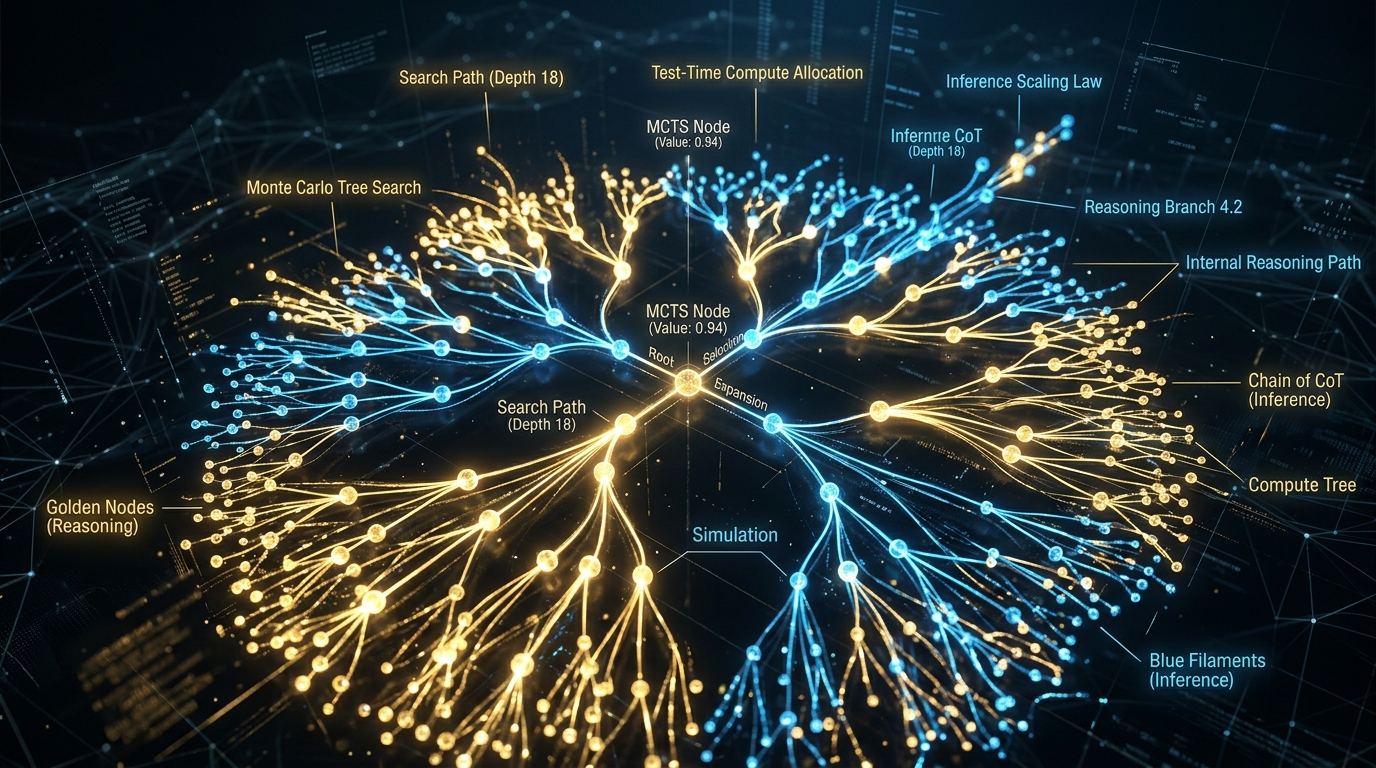
1. The Transition from Pre-Training to Test-Time Scaling
The historical trajectory of deep learning was defined by pre-training scaling: train a bigger transformer on more internet text, and capability will emerge predictably. However, two hard boundaries emerged by late 2024: the exhaustion of high-quality human-authored text on the public internet, and the asymptotic cost curves of training runs exceeding hundreds of millions of dollars.
In response, AI research discovered an untapped dimension: inference compute scaling. Instead of forcing a model to predict the next token instantly within 50 milliseconds, modern reasoning architectures allow the system to spend 10 to 120 seconds formulating an internal chain-of-thought. In this paradigm, compute is expended at runtime to verify logic, backtrack from false assumptions, and prune incorrect search trajectories.
Inference Scaling Law: AIME 2024 Math Accuracy vs Thinking Budget
Solve Rate (%) as test-time reasoning token allocation expands
Scaling Benchmark
88.2% Accuracy • Peak Performance
81.5% Accuracy • Strong Parity
72.3% Accuracy • Efficient Sweetspot
22.4% Accuracy • Brittle Intuition
Demonstrating clear logarithmic scaling as thinking tokens scale from 0 to 64k
2. Algorithmic Mechanics: Search, PRMs, and MCTS
Test-time compute is not merely generating longer verbose answers. It is powered by distinct algorithmic strategies:
- Process Reward Models (PRMs): Unlike traditional Outcome Reward Models (ORMs) that evaluate only whether a final answer is correct, PRMs score every single intermediate step of mathematical or logical deduction. This allows the system to identify the exact point where a false assertion occurred.
- Monte Carlo Tree Search (MCTS) & Best-of-N: During inference, the engine samples multiple candidate trajectories. When a branch receives a low confidence score from the PRM, the generator backtracks and explores alternative semantic paths.
- Reinforcement Learning over Thinking Traces (RLVR): Models like DeepSeek-R1 proved that pure reinforcement learning (RL) applied to verifiable rewards (rule-based math checkers, compiler exits) can teach models to autonomously discover reflection, verification, and error correction without supervised human demonstrations.
3. Token Economics: Trading Latency for Quality
Test-time compute fundamentally changes the cost structure of AI deployment. In traditional zero-shot LLM queries, latency is proportional only to prompt length and response length. In reasoning models, users trade latency and token volume for correctness:
| Deployment Tier | Thinking Budget Range | Typical Latency (TTFT) | Primary Use Cases |
|---|---|---|---|
| Fast / Conversational | 0 Tokens (Zero-shot) | 150 ms – 300 ms | Chat UI, translation, summarization, autocomplete |
| Standard Agentic | 1,000 – 4,000 Tokens | 1.5 s – 4.0 s | Code refactoring, SQL query generation, doc parsing |
| Deep Reasoning | 8,000 – 32,000 Tokens | 8.0 s – 25.0 s | AIME mathematics, complex security audits, formal proofs |
| Autonomous Frontier | 64,000+ Tokens | 45.0 s – 120.0 s | Novel algorithm design, multi-file zero-day vulnerability discovery |
Drawbacks, Limitations & Risks
- Exponential Billing Traps: Because reasoning tokens are billed as output tokens, an un-capped reasoning query on a difficult edge case can generate 30,000+ thinking tokens for a single request, resulting in 20x higher bills.
- High Turnaround Latency: Waiting 30 to 60 seconds for a response disrupts interactive synchronous user experiences, necessitating asynchronous webhook architecture.
- Overthinking on Simple Prompts: Without dynamic budget adaptation, reasoning models can waste thousands of tokens deliberating over trivial queries that a simple 8B model could answer in 100ms.
Recommended Production Architecture
When implementing test-time reasoning models in production applications, decoupling your front-end web tier from long-running inference jobs using scalable cloud servers like Cloudways ensures HTTP connections do not timeout while models think. Furthermore, routing automated benchmark evaluations and private corporate datasets through encrypted tunnels with NordVPN prevents corporate telemetry leakage.
Frequently Asked Questions
What are test-time compute scaling laws?
Test-time compute scaling laws state that model performance on verifiable reasoning tasks scales predictably with the amount of computational resources and thinking tokens allocated during inference, rather than solely during pre-training.
What is the difference between reasoning tokens and output tokens?
Reasoning tokens represent the internal chain-of-thought generated by the model to plan, verify, and correct its work. While they are usually hidden from the final user UI, they consume GPU compute and are billed by API providers as output tokens.
Can test-time compute fix factual hallucinations?
Test-time compute significantly reduces logical and mathematical errors because the model verifies each intermediate deduction. However, for factual knowledge that was never in the training data, test-time compute cannot magically create facts without external retrieval (RAG) tools.
Which models currently support test-time compute?
Leading implementations include OpenAI’s o1 and o3-mini, Anthropic’s Claude 3.7 Sonnet (via its Extended Thinking parameter), and open-weights models like DeepSeek-R1.