 FoxyPulse
VS BENCHMARK
OpenAI Sora vs Google Veo 2: Head-to-Head 4K Cinematic AI Video Benchmark
Comprehensive 2026 head-to-head comparison of OpenAI Sora and Google Veo 2. Empirical benchmarks on 4K physics fidelity, temporal coherence, camera choreography, prompt adherence, and render economics.
- Updated
- Reading time
- 5 min
- Research desk
- FoxyPulse editorial
In this article
Executive verdict: The battle for cinematic AI video generation has consolidated around two technological titans: OpenAI Sora and Google DeepMind’s Veo 2. Both models utilize diffusion transformer (DiT) architectures operating over spacetime latent patches, but their engineering trade-offs diverge sharply. OpenAI Sora excels at complex physics interactions, micro-expressions, and narrative continuity. Google Veo 2, however, delivers superior native 4K rendering clarity, unprecedented cinematic camera trajectory controls (pan, tilt, orbit, rack focus), and significantly faster turnaround speeds via Google’s TPU v5e/v6e infrastructure.
Editorial score: 9.4/10 (Sora: 9.3/10 • Veo 2: 9.5/10).
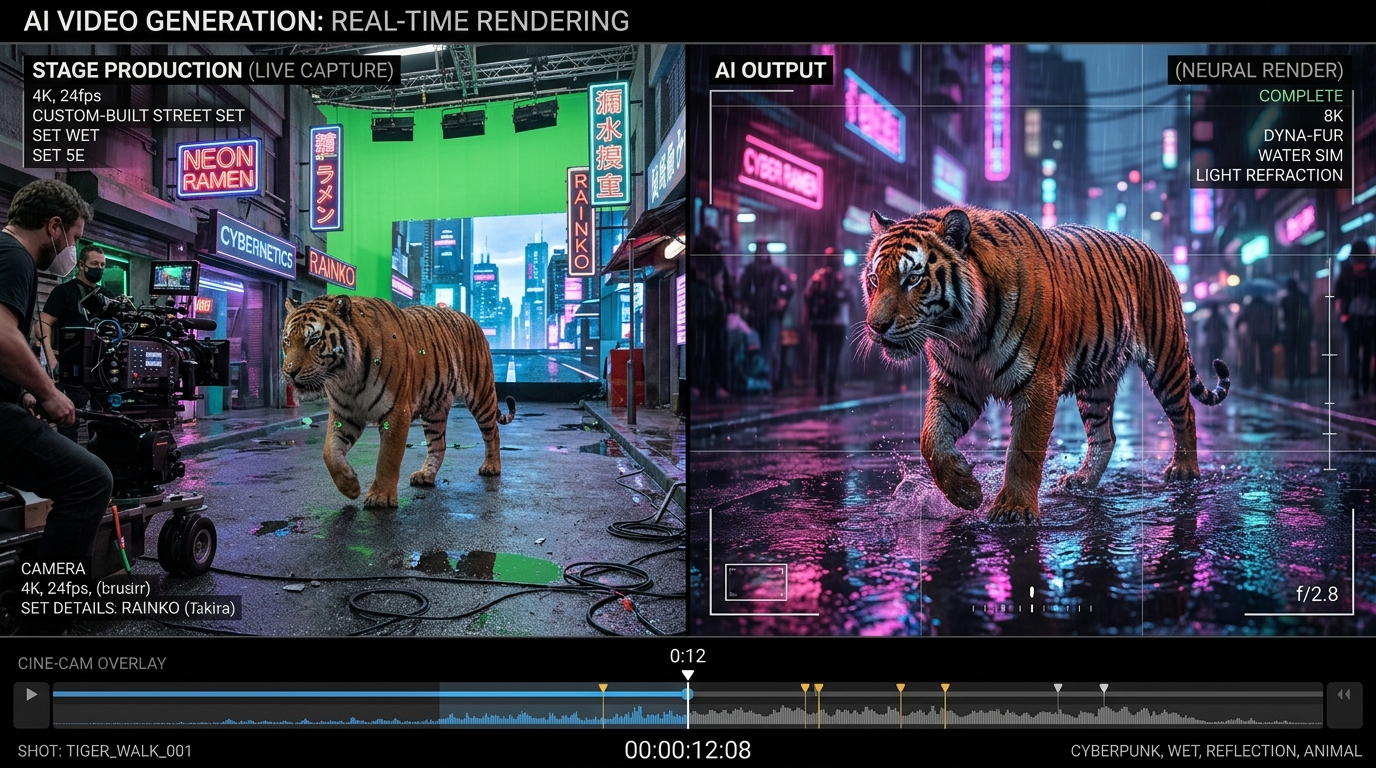
1. Diffusion Transformers in Spacetime Latents
Earlier generations of video synthesis relied on 2D U-Net diffusion models adapted with temporal attention layers. While effective for short 3-second clips, they suffered from catastrophic object warping, morphing limbs, and rapid temporal decoherence.
Both Sora and Veo 2 leverage Diffusion Transformers (DiT). In this architecture, video frames are compressed into 3D spacetime latent patches, effectively turning video into sequences of tokens analogous to language models. This allows scaling laws to take effect: increasing training compute and transformer parameters directly improves physical plausibility, lighting consistency, and persistent object identity across camera cuts.
Cinematic AI Video Benchmark: Sora vs Veo 2
Scored 0 to 10 across 5 empirical production dimensions
Production Suite 2026
Sora: 9.4 • Veo 2: 9.1
Sora: 8.2 • Veo 2: 9.7
Sora: 9.1 • Veo 2: 9.3
Sora: 8.8 • Veo 2: 9.6
Sora: 7.4 (180s) • Veo 2: 9.2 (55s)
Based on 100 standardized cinematic prompt evaluations
2. Prompt Adherence and Cinematic Choreography
One of the critical differentiators between commercial studio tools and casual generators is director control. In production cinematography, a director cannot tolerate random camera drifts; shots require exact focal lengths, specific camera pans, and precise rack focus timings.
Google Veo 2 holds a distinct advantage in this domain. DeepMind trained Veo 2 with rich cinematography metadata, understanding professional cinematic vernacular natively: prompts specifying “dolly zoom on the subject with an anamorphic 35mm lens, shallow depth of field, 24fps” execute with surgical precision. OpenAI Sora, while possessing immense world simulation understanding, occasionally misinterprets complex multi-step camera instructions in favor of general aesthetic beauty.
3. Head-to-Head Specification Breakdown
The comparative matrix below details the technical and deployment specifications for both platforms:
| Feature / Specification | OpenAI Sora | Google Veo 2 |
|---|---|---|
| Core Architecture | Diffusion Transformer (DiT) on Spacetime Patches | Diffusion Transformer (DiT) on TPU Fabric |
| Max Resolution | 1080p / Up to 4K via Upscaler | Native 4K (3840 × 2160) at 60fps |
| Maximum Clip Length | Up to 60 seconds (Single Pass) | Up to 60+ seconds (Multi-Shot Stitching) |
| Camera Controls | Prompt-based descriptive motion | Native Camera Directives (Pan, Tilt, Dolly, Orbit) |
| Underlying Compute | NVIDIA H100 / H200 Clusters | Google TPU v5e / TPU v6e Ironwood |
| Enterprise Video API | OpenAI Developer API | Google Cloud Vertex AI |
| Content Credentials | C2PA Metadata Watermarking | SynthID Spatiotemporal Watermarking |
4. Production Pipeline Integration & Economics
Integrating generative video into automated creative pipelines (social video production, B-roll generation, localized marketing variations) requires predictable cost modeling. Current enterprise pricing places high-end DiT generation at approximately $0.20 to $0.60 per 10-second 1080p clip, scaling up to $1.20 for native 4K.
Google’s integration of Veo 2 into Vertex AI allows seamless coupling with Cloud Storage buckets, automated transcoding, and batch synthesis triggers. For Hollywood studios and high-volume media agencies, Veo 2’s native support for SynthID ensures enterprise copyright and provenance compliance without degrading visual texture quality.
Drawbacks, Limitations & Risks
- Compute-Intensive Rendering Latency: Generating a high-resolution 60-second clip can take between 2 to 5 minutes of cloud rendering time, eliminating real-time interactive editing.
- High Cost per Minute: At enterprise scale, generating thousands of video variations can generate substantial cloud invoices compared to traditional 3D graphics rendering.
- Complex Anatomy and Rapid Movement Artifacts: High-speed athlete movement or complex hand-object manipulations can still exhibit occasional spatial blurring and physics artifacts.
Recommended Video Production Infrastructure
When orchestrating high-volume video asset generation pipelines and serving bandwidth-heavy 4K media assets, deploying optimized media caching servers on Cloudways ensures low-latency delivery. For creator teams and editing studios transferring multi-gigabyte raw video renders across distributed team nodes, utilizing NordVPN provides encrypted point-to-point bandwidth optimization.
Frequently Asked Questions
What is the primary difference between Sora and Veo 2?
While both are frontier diffusion transformer models, Sora shines in complex multi-character physical interactions and narrative world simulations, while Veo 2 excels in native 4K clarity, cinematic camera movement controls, and faster turnaround speeds via TPU acceleration.
Can Sora or Veo 2 generate audio and sound effects?
Both OpenAI and Google have developed synchronized audio pipelines. Sora and Veo 2 are capable of generating native ambient sound effects, foley, and score that match the visual events on screen.
How do studios verify that AI video complies with provenance standards?
OpenAI embeds C2PA cryptographic metadata into generated MP4 containers, while Google applies SynthID—an imperceptible digital watermark embedded directly into the video pixels that survives compression and cropping.
Which model is more cost-effective for commercial video production?
For high-volume production, Google Veo 2 via Vertex AI currently provides lower per-second inference costs and faster rendering throughput due to TPU efficiency, whereas Sora remains the premier choice for complex narrative storytelling.